3 Jun 2008

The DusiMfula

What an experience! To us at the back of the race, this was more than an adventure. Travelling through the valley of a 1000 hills, through rivers which we crossed about 8 times, crawling up Burma Hill, carrying bikes instead of cycling, using brute force to get our bikes over obstacles, surviving all to arrive victorious at the end. Awesome! Maybe only to be done once, unless you have trained numerous, endless hours of single track. But let me start at the beginning.......
We set off in high spirits, some of us in cars, others in planes, but our destination was the same, Pietermaritzburg. We were ready for the DusiMfula mountain bike race.

After a jolly night out, we had our bikes took a closer look at the countryside it was going to cycle through. The day started a bit misty and one could eavesdrop the other riders' conversations about what to wear..is it going to rain, is it going to clear and get warmer?

While I was wandering around looking at rider clothing and bikes and accessories I marveled at the line of Loos. Something that the roadies just don't seem to get right....enough loos for allThe start of Day 1, and the dirt road was jam packed with riders, all ready to go flying when the gun would go off.
Team 178, our friends Lambert and Fanie looked very relaxed, although a bit too warmly dressed. It took them about 1km to get rid of their jackets. That was also the last time we saw them. They were showered and relaxed by the time we came in at the end of the day.
Next to them at the start were us, The Bulla Team, Rodney and Gerda. We took a more scenic approach to the ride.

After the first couple of kilometres, we realised this is going to be one tough ride. From a wide but steep roller coaster start to a single track, to cut-grassed jeep track, all the time, in the now familiar roller coaster fashion. It wasn't long before many a rider had to get off their bikes to push.
Then a steep downhill followed to the first river crossing, The Cascades, where we had to queue in line for about 40min to wait our turn to cross the river. The first of about 8 river crossings.


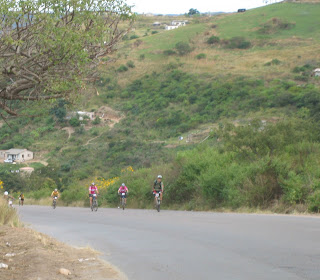
The route took us through the countryside and next to the river


until we eventually reached, high on the top of the mountain, the water point. By that time some riders have had enough and their bikes were loaded on top of the sweep vehicle, strapped to the roof, with the tired rider hanging over the bonnet.

The view from up there was just so beautiful. While I was taking in the view and got myself photographed and filled my water bottle, the rest of the team made their appearance.

Only 26km to go to the end of Day One. Doesn't sound like a lot, but believe me, there were still a number of climbs, obstacles and dongas to cross. We laboured on and when we finally reached the end and could see the dam, the tents, we knew we finally made day one. We were presented with a snack pack. What a nice surprise! A roll, a fruit, a chocolate and a muffin which were absolutely devoured. I didn't realised how hungry I was. The bulla team took 7hours and 53 min to complete day 1, about 75km.
All the teams had their numbered tents waiting for them, all equipped with two thick sponge mattresses.


............. and the tent inhabitants.........


Day Two dawned a bit cloudy, but not cold. We settled down for a very early breakfast and then the big packing up as our bags had to be with the Crown removals truck by 6:30. The race started at 7:00. After the wonderfully prepared supper the previous night, we slept like logs. Breakfast was an equally sumptuous feast, from cereals to bacon and egg rolls, to muffins and enough coffee to wake up the sleepiest of the sleepers, except for one team who thought that the race only starts at 8 and was therefore an hour late..

With our bags packed and our bikes lubed and checked, we were ready for the second day, or so we thought. They announced that Day One was a technical ride, don't we just know it, and Day Two was to be the adventure. Standing in the chute waiting for the start gun, my eyes wandered to the cyclists legs around me, bruised, scratched, maybe also tired, but also some very strong and lean muscles. STIHL was the company who cut the paths during the previous day and apparently through the night so it was ride-able. I saw a couple of their riders around at the start.

The gun went off and we were on our way with the media helicopter hovering over us, always taking footage of the front runners. What about me! What about me! True to the ride of Day One, Day Two was also littered with uphills, steep hills, out of breath hills. It just gave us enough time to catch our breath and sneak a look down on Inanda Dam, our overnight stop of Day One. What a view! Before we knew it, we were at Burma Hill, the dreaded hill. It was dragging, pushing, shoving, carrying, and more carrying our bikes up, up and up the hill. Nobody seem to be in a hurry. All were just slowly making their way up.While some were admiring the view over the valley from the top, others were still making their way up. The welcoming committee were waiting up at the top in case somebody wanted to hand over their bike and walk the rest of the route. At last the water point. Loud music was pouring out the house and friendly people were clapping as we came round the corner. A very welcome sight. ........Did you see the dog?

Just when we thought we could have it a bit easy, another big hill followed. Our Pink teammates, Pauline and Etienne battled it out on the hill. The previous day, they were the yellow team and they were welcomed in with a huge Mexican wave and fanfare and an interview on TV.
Then the fall... Pauline came down on the single track. "I'm OK, I'm OK". So we left them to the dusting off and checking the bike and went our merry way........


across the bridge
and crossing the river over a bridge. There should be other terms for "bridge".......
and crossing the pipe bridge covered with rickety planks and at a dizzy height!.......and across the bridge built by the army, with some members in a rubber duck in case we decided to take a tumble into the river........and all the way to the end!And it was only at the end that we heard the shocking news, that Pauline's fall was a bit more serious and that "I'm OK" actually means "I'm not OK and that I'm in excruciating pain but I'll smile with my front teeth and grind the back ones." Arm in sling but with a smile on her face we did get to see her at the end too, with a beer.
I'm sad to say, Etienne got hurt too........luckily not seriously..........just a bit........... a small wound.
And so a wonderful, but very tough and tiring, event came to an end. We did celebrate and explore Durban's night life. The smell of the sea, the views. Till next year. ....Maybe

21 May 2008

I want to ride my bicycle!

I want to ride my bicycle......I think I know how, until I fall off, and then I wonder. You do know though that you get two kinds of cyclists; those that had a fall and those who are still going to fall. Those on the road seem to get it pretty right without too much falling, but if you are like me on a mountain bike, I look for a place to fall.

So if you are like me and would like to sharpen your bike skills, here follows a video to watch and see how the pros are doing it. The bunny hop, hopping over tree stumps,.... dead animals,...... anything that might be in the way of you and you riding your bike. Suggestion; try with smaller objects first.

Keep practicing and let us know how it's going.
To be continued .......... to more advanced moves.

7 May 2008

The Spinning Bike

I found this spinning bike while hunting through the internet and I found the bike beautiful and the blog hugely entertaining.


LeMond RevMaster
(EDM #103)
January 22, 2007 by Jana Bouc

Lamy Safari pen and ink with crayon in Aquabee sketchbook
This week’s EDM challenge is to draw your exercise equipment so here’s my LeMond RevMaster spinning bike which I like very much. I probably would have been better off riding it than drawing it tonight…or just going to bed. I started the drawing four times, but kept running out of room on the page. I finally got most of it on the page and then made the mistake of coloring it with Caran D’Arche Neocolor wax crayons (yuck).

6 May 2008

Fit, Fitter, Fittest

Change the "i" to an "a" and you will have a total different heading. I was contemplating today that one finds so many programmes to help existing cyclists/runners get fitter and faster, but what about the other side of the spectrum. So here is a training programme to change the"a" into an "i".


  • The first very important point to remember is that there are 7 days in a week.
  • Secondly, get to wear the right gear. You don't play tennis in flops, .....so for a comfortable workout, dress correctly.
  • Thirdly, check with your doctor that you can start with a fitness programme. It is no good starting with stomach exercises on the ball, if you are still recovering after a tummy tuck op!
  • Point number four: Rome wasn't built in a day, so you have to keep going for at least six weeks before giving up, ok.
All ready? Roll off the couch then, here we start! Identify with which group you think you'll best fit in and start with that programme.

Just off the Couch-(potato): This is you, if you haven't done any training for the last 6-12 months (or longer). Start off with 2 spin classes per week and 1 strength training (power training) per week. Strength training is done on the Bosu Ball here at the gym and will help to firm and shape the flab. 2+1 = 3, only 3 days of the 7 days of your week are used. This is truly the minimum that you should do. Anything less is not part of a programme.

Couch Potato turned Fitness Enthusiast: This is you, after starting the programme six weeks ago and is still going strong. Done that, got the T-shirt, remember.?
  • 2 spin classes per week plus 2 strength training classes per week .....or
  • 3 spin classes per week and 1 strength training class per week
  • 2+2=4, 3+1=4; any which way gives you 4 days of your 7 day week. Keep this going for the next six weeks and tell us about a different and new you.

Fitness Enthusiast turned "Regular": This is you arriving on the minute before class is starting, but your bike is already correctly set up and all other "non-regulars" aren't allowed to sit on your bike. You know the drill, you've got the gear but you see little progress. Try this:

  • 3 spin classes per week plus 2 strength training classes per week ...or
  • 3 spin classes per week plus 1 double spin class plus 2 strength training classes per week..or
  • 2 spin classes plus 1 double class plus 2 strength training classes per week.

You will only use 5 of your 7 days per week. Remember you can always combine a spin class with a strength training class, starting off with the strength training class and then when your muscles are nice and warm, go over to the spin class.

Always remember to keep your training fresh. Try to spin different times of the day or go to another instructor's class. Here at Bulla they're all good. Get a new outfit! Anything, to keep you motivated and to keep you going. Don't be afraid to use the resistance knob in spinning. Try to do all the reps in the strength class. After 6 weeks it will be a new you facing you in the mirror.

Fitness Freak: I'm sorry I don't know anyone like that. ....But if you want to, you can always join some of us on a ride over the weekend.


4 May 2008

Cranky Monkey Farm


OPEN DAY AT CRANKY PARK
Winter is also an ideal time to fine tune mountain bike skills. The Cranky Monkey Skills Park will open mid-May and with three skill drill areas, you will be guided through a series of drills to take you from zero to hero in no time. The park has taken a little longer to complete, but promises to be something spectacular. The opening weekend is 10/11th May and you are invited to come and ride at the park free of charge. Instructors will be on hand to assist and you will be able to book future group or one-on-one sessions at the venue. Visit www.crankymonkey.co.za and see for yourself.
Now that sounds ideal in doing something different. Go and check it out, see what it is all about. I'm sure you will enjoy it.
Sorry about the Breakfast Ride not taking place this last weekend. Yes, as you've gathered, with the sudden introduction of another public holiday , we here at Bulla had to cancel our breakfast ride as it was now falling on a long weekend and many riders took a break. Watch this space as we will definitely plan another fun ride.
Hopefully you are all still training hard for the next ride, the Bela Bela. Still a couple more days to enter.
By the way, what are you planning during the winter months to keep your fitness levels up? Easy to slide backwards, isn't it? Let us know of your fitness plans to help motivate others getting fitter during the winter months.

15 Apr 2008

Something interesting to chew on

Well I think I have something interesting for you to chew on. What do you think you will need to ride these mountains?

According to the professionals, the main factors in fitness are the brain, the will and...knowledge.
Now have you ever thought of training with that in mind?


PS. This is the Baviaans route... Impressive!


See you at the Baviaans Braai.

10 Apr 2008

Doing the Trans Baviaans


Doing the Trans Baviaans (TB)
Christo de Kock

Competing is all about winning. Beating your toughest opponent is very rewarding especially if he/she is yourself. This is what the Trans Baviaans is all about: BEATING YOURSELF!!!
The TB offers you the opportunity to prove that you can exceed your own physical and mental abilities. The reward is extreme personal satisfaction that cannot be explained unless you have done it.

230 km in 24 hours at approx 10km/hour sounds easy until you try it. Even if you have trained extremely hard, followed the right diet, have the latest high tech carbon fibre all gadget imported bike, you will not succeed without the right attitude. I.e. completing the TB is in your head/mind and not in your legs!!!!!

Things you should do before the race:
First of all choose your backup team before you even enter the race (not more than 2 members in the team). When you suffer you need the best support that you can get. I mean get the best. Your success is directly dependant on the support that you get during the race. Hey, and remember to recognise their contribution when you get your medal at the end! You should always thank your support team before, during and after the race.

Then choose your partner and train with him

Attributes of a good partner:
o Should not be aggressive/moody/negative unpredictable or different when tired (this will cost you dearly)
o Both should be at the same physical level or he/she should be slightly better than yourself (This will allow you to do better times)
o He must have “vasbyt” (this is the most important attribute). It goes without saying that you should have “vasbyt” too!!!
o Must be willing to work together. There will be times in the race that one of you will be more tired than the other one. This is when you must help each other.
o He should have the right mindset, i.e. not win at all cost but enjoy, compete and finish with a smile on your faces.

You have to train right for this event
Start in January (the race is in August). You need power and endurance. Power will allow you to climb the mountains on your bike and enable you to cycle the whole race without cramping. Endurance will get you to the end. You have to cross train. Build power in your legs (quads, hamstrings and calves) through power exercises. Do this at least 3 times per week. The trick here is to do the power exercises with your heart rate low – go slow. Always do stomach exercises; this is essential for all sport disciplines. For endurance you have to go to the road. Do regular long distances (approx 100km) at medium pace. Do this at least twice per month if you can. You should also do a few mountain bike races to experience group riding. During the week you must do high impact training, sessions of approximately 1 hour at high heart rate. Example, do 1 hour of Hans Strydom, up and down or join a spinning gym (Try Bulla they are not too bad). Finally, establish a training routine and also have fun while you prepare.
Nutrition.
Eat right from the beginning. You cannot prepare your body for the race during the last month. Personally I do not believe in expensive chemical supplements anymore, their effect is overrated. Eat a healthy balanced diet: “Rys, vleis en aartapels”, veggies, lots of fruit and nuts and the occasional cold beer to wash it all down. I also take SlowMag and Omega 3+6. It is easy to get hold of a health diet for sportsmen, just surf the web there are many available. It is really not a good idea to drink too much alcohol the night before a race or hard exercise. If you do not believe me try it out for yourself (2 cold beers or glasses of red wine should not affect you but 2 boxes and bottles will!).

Your Bike.
First question how much money do you have? You don’t need the latest and best bike on the market, but at least buy one with good quality gears (better than average), good brakes (V-blocks or discs will do) and a comfortable saddle (a sore ass can spoil everything). Use tubeless tyres with slime, nothing else!!! You will never have a flat tyre again. Weight is a factor. Remember that it will take at lot of energy to move dead weight up and down the route. This will definitely have an impact on your performance over a 200+ km race. An aluminium frame is adequate (steel is to heavy). There is no sense in having a 6 kg carbon fibre frame and the load your bike with 6 kg spares and equipment. You need only the necessary spares with you on your bike for quick repairs. The rest for major repairs should travel with your support team. I think you need the following with you (remember to train with your spares)
o Spare tube if you cut a side wall
o Tyre levers and tube repair kit if you puncture the replacement tyre.
o Small pump (I cant afford the expensive gas canisters)
o Put a master link in your chain and carry a spare link. You will need a chain breaker to change a link (make sure the link fits your specific chain make). The chain should not break under normal circumstances but if it does, you will be prepared.
o Spare break blocks if you have a V-block break set (it is much easier to change brake pads on a V-brake system than the discs on a disc brake system)
o Allen keys to fasten screws on your bike (you can buy a compact Allen key set with all the necessary sizes)
o Small bottle of dry lubricant for wet and dry conditions to ensure smooth gear movement and transition.
o Small bottle of slime just in case you need to add after a major puncture.
o Spare batteries for your lights (later more about this)
o Nutrition during race (more later)

Things you should send with your support team:
o Spare front and back wheel if you can afford it (one set per team should suffice). My view, rather ride conservatively in difficult areas to protect yourself and your equipment, this will reduce the risk of falling that can cause serious damage to your bike. Also train in difficult areas before the race. This will improve your skills and prevent unforced accidents.
o Spare chain
o More tools, pliers, hammer "don't give Rodney a hammer " (small one, full set of spanners and sockets, screwdrivers.
o Spare tyres and more spare tubes
o Bike stand
o Extra food/nutrition (more later)

It is extremely important to ensure that your bike is well maintained before the race.
Clean it after each ride. Cleaning is very important. Use Kleen Green to remove dirt from the frame and mechanisms and paraffin to clean moving parts. Wash off the Kleen Green with low-pressure water. It is important to note that moving parts such as the chain and bearings in the wheels and pedals contains lubricant (factory fitted) to ensure easy movement. If you clean these areas with petrol, thinners, acetone etc. you will wash away the lubricant. This can lead to failure of the moving parts of your bike. Rather use paraffin. After wash, dry your bike and lubricate the chain and other moving parts. Oil the cables of the gears and brakes to prevent rust. You need to replace the chain after a certain amount of wear and tear. Find a good bike service centre and get their opinion (if you cycle regularly at least every 2 years). You should also service your bike at least once a year. They will check it out for you and by doing so prevent failures during training and races. Do a major service where they strip, lubricate, check and rebuild your bike. This should not cost more the R200.00

The slime in your tyres should be topped up regularly. Note that the tension in the gear cables relaxes over time and cause the chain to slip on the back gear set (this is extremely irritating). To fix this you can adjust the tension of the gear cable with the setscrew at the top of the derailleur. Turn it inwards or outwards with the back wheel in the air while you move the pedals with your hand at a medium pace. Shift the gears up and down until you have smooth transition. If this fails take your bike for a service.

The lights.
Very important!! My experience and I have done a number of night rides. You don’t need a light stronger than the sun. Such a thing is heavy, hard on batteries and expensive. You need a Petzl diode headlamp (I only buy Petzl the rest is junk!) The battery life is long and you don’t need spare batteries. You need a rear red light. They are cheap, use a diode type, the batteries last a long time. Then the most important is the spot light. This is required to show you where to go and if there are obstacles in the road to be avoided. If Bill Gates sponsors you ask him to buy the best. This can cost you (him) approximately R5000.00 or more (surf the web for more info or visit Cycle Lab or equivalent). There are many types of lights available and you will hear many opinions. If you are like me (not sponsored by Bill) consider the following and buy what you can afford:

o It must be easy to attach and remove it from your bike handle bar.
o It must be positively secured to your bike. Don’t use clip on lights. Those are for sissies riding on smooth surfaces and will not work for the TB, the terrain does not allow for this. Remember if you loose your lights your race is over!!!
o The batteries must last for at least 4 hours. Your support team will carry spare batteries. Use rechargeable Metal Hidrate batteries rather than NiCads. They last longer and are more reliable.
o Compare diode type lamps with bulb type lamps. Diode type use less batteries but are more expensive (they give a white light). Bulb types are less expensive but use more battery power (they give a more yellow light).
o Set the lights to shine approx 20m in front of your bike in the road.
o Test your lights BEFORE the race at NIGHT on rough terrain.
o Your lights must be waterproof.
o Total light assembly must be as light as you can afford.

Make sure that your drinking system is properly secured to either your body or your bike.
The road is very bumpy and if not secured properly you can loose a bottle or two. A camel back drinking system is very expensive (approx R1000.00) but works very well (check it out before the race, for some people the weight on you back can be disruptive and hurt your lower back). Carry at least 2 litres of fluid with you. 1 litre should be an energy drink (e.g. USN Cyto Power or Engergen etc.) and 1 litre pure water (you get tired of sweet stuff after a while. Fill up the fluids at the checkpoints. Running out of water is disastrous and bad for your health.

Things you should do during the race:
Make maximum use of favourable conditions. If the wind blows from behind go faster. Ride in a slip if you can. Keep going during the day. Don’t rest for too long (preferable only at the check points) don’t stop between checkpoints.
·Ride competitively not stupidly. Rather go slower down hill without falling. You lose a lot of time fixing your bike.
· Carry your bike through the deeper rivers. There are rocks below the water that can damage your bike.
· Keep pedalling uphill if you can. Just keep going.
· You have to plan your race. Familiarise yourself with the route and set goals e.g. I have to be at a certain point before a certain time.
· Plan what you are going to send with the support and back up teams.
· The right nutrition during the race cannot be emphasised enough. The TB takes a lot out of your body and you have to replace this during the race in order to finish.
· Firstly you have to drink enough fluids. Don’t wait until you feel you have to drink, drink regularly (at least 200ml each half hour). Your energy drink will replenish your body salt and electrolytes. This will provide quick energy when you feel tired. Drink clean water to replace lost body fluids caused by sweating and to get the sweet taste out of your mouth. You can also drink diluted Coke (half Coke half water) Experiment before the race to find the most effective drink for your body. Plain Energade or PowerAde is not “strong” enough.
· You have to eat during the race. Don’t over eat but surviving on fluids only will not get you through. An energy gel will provide instant energy at the beginning of the race but will have no effect after approximately 6 hours in the saddle. Your body requires solid food as well. I eat the following: bananas, bread with a very thick layer of peanut butter (this works very well), hot bean soup at the check points (stay down wind for side effects), nuts, biltong, jelly beans and a Bar One, Again plan what to take with you on the bike and replenish at the check points and from your support team. Remember that when you are tired you don’t feel like eating BUT you have to force yourself!!
· Enjoy, appreciate and experience the scenery. The TB goes through a spectacular nature reserve. Don’t compete so much that you miss out on this. You have to enjoy the race!!!
· Carry a pack of Norflexco (or similar) tablets just in case. If you really cramp badly this will get you through (drink lots of water with the tables if you take them)
· Ensure that your bike is in good running condition throughout the race (do preventative maintenance). Check the break pads at check points, regularly lubricate your bike chain, check your brake and gear cables, and remove excessive mud from the breaks and gears.

Things you should not do during the race:
· Don’t start too fast (leave this to the young guys, you will pass them again later in the race, guaranteed)
· Don’t ever give up. If you do this you will not finish the race, i.e. you loose against yourself!
· Don’t pass a fellow competitor in need. Later on it can be you, remember you are not trying to beat everyone on the race, just yourself.
· Don’t give up
· Don’t go too fast, pace yourself.
· Don’t give up if you get lost. You will forever regret this.
· Don’t forget to thank your support team
· Don’t throw your bike down when you get off (put it down with the derailleur facing upwards). You will need your bike in good condition to finish the race. Also note that there are many thorns along the track, especially at the checkpoints.
· Don’t cycle uphill in the wrong gear (you can break the chain). Make sure you understand the term “cadence”, i.e. select an easier gear for up hills, your forward speed will go down but you will require less power to pedal.
· Don’t loose your concentration towards the end of the race. If you do you will crash or fall or under extreme conditions collide with a stray wild animal or two.
· Never get irritated with your partner/s. Sort this out before the race or get the right partner.
· Don’t ever give up.

Finally 10 km from the end.
When you pass the last checkpoint and hit the tar road you will know that there is no stopping you now. You have almost made it (if it is your first time you will now be nervous, emotional and very very tired) You will be glad that it is dark to hide your wet face caused by 13 hours plus of sweat and recently added tears of achievement. Suddenly you will have more energy and you will start pedalling faster. You will see the lights of Jeffreys Bay and know that the end is near. You will look down to your trip meter indicating 225 km. It was set on distance for the whole race – your average speed on the TB is not important because you are definitely not an average individual to complete this race.

At the last turn into the caravan park you will be looking for the welcoming sight of your support team (that is if they have also made it safely to the end without getting lost). By now you and your partner are partners for life. You have made it. You have completed the TB and conquered yourself.

Winning against yourself is completing the Trans Baviaans within 24 hours, loosing against yourself is not to enter.

Now that you know what it is all about , please join us at the gym on Friday 18 April, round about 18:00 for a braai. Bring your meat and drinks, we will provide the rest. Just be there!


Many thanks to Christo for a brilliant article of this magnificent ride! Not to be missed .... ever!